

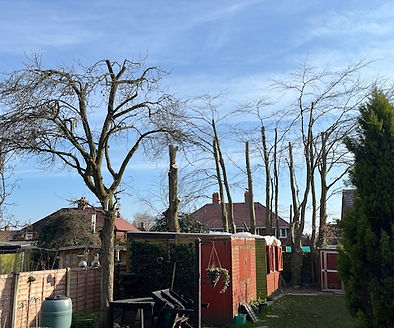
Can you make a tree smaller without removing it?
In many cases, yes.
A tree that has become too large for its location does not automatically need to be felled. Depending on the species, condition and structure of the tree, professional pruning may be able to reduce its overall size.
One of the techniques that may be considered is crown reduction.
The important point is that reducing a tree properly is very different from simply cutting the top off it.
What is crown reduction?
Crown reduction involves reducing the overall height and/or spread of a tree's crown while attempting to maintain a balanced and appropriate shape.
Branches are selectively shortened back to suitable growth points rather than being cut indiscriminately.
The amount that can reasonably be removed depends on the individual tree.
Some trees tolerate reduction better than others, and excessive pruning can create unnecessary stress or encourage large amounts of vigorous regrowth.
Why might a tree need reducing?
Trees are often planted when they are relatively small, but many species eventually develop into very large mature trees.
Years later, the tree may begin to dominate a garden or grow closer to buildings, neighbouring properties or other structures.
A reduction may be considered where the objective is to manage issues such as excessive spread, branches approaching buildings, an overextended crown or a tree that has simply become too large for the available space.
Does crown reduction permanently stop a tree growing?
No.
Trees are living organisms and will normally continue to produce new growth following pruning.
Crown reduction should therefore be considered a management technique rather than a permanent method of keeping a tree at exactly the same size.
How quickly the crown develops again will depend on factors including the species, age and health of the tree.
Some fast-growing trees may require future pruning sooner than slower-growing species.
How much can you reduce a tree?
There is no single percentage that is suitable for every tree.
The appropriate amount depends on the species, age, health, previous pruning, branch structure and reason for carrying out the work.
Removing too much of the crown at once can negatively affect a tree and may result in excessive regrowth.
A sensible reduction aims to achieve the required improvement without unnecessarily removing healthy growth.
Is reducing a tree better than cutting it down?
Where a healthy tree can reasonably be retained, reduction may provide an alternative to complete removal.
Mature trees can provide shade, screening, wildlife habitat and significant visual value within a garden.
However, retaining a tree is not always practical.
A tree may be unsuitable for its location, in poor condition or affected by structural problems that mean reduction would not resolve the underlying issue.
The right decision depends on the individual tree rather than assuming reduction or removal is always the better option.
What is the difference between crown reduction and tree topping?
Proper crown reduction involves selectively shortening branches back to suitable pruning points while maintaining an appropriate crown structure.
Topping generally describes indiscriminately cutting major branches or the upper crown back without consideration for suitable growth points or the resulting structure.
Heavy topping can leave large pruning wounds and encourage vigorous regrowth.
If the objective is simply to make a tree smaller, it is still important to consider how the tree will respond afterwards.
Could crown raising solve the problem instead?
Sometimes the overall size of the tree is not actually the issue.
If lower branches are obstructing a driveway, footpath, lawn or access underneath the tree, crown raising may provide the required clearance without reducing the whole crown.
Crown raising involves selectively removing or shortening lower branches to increase the usable space beneath the tree.
Choosing the correct type of pruning can avoid unnecessary work.
What if the crown is simply too dense?
Where crown density is the concern rather than overall size, crown thinning may sometimes be considered.
Crown thinning selectively removes a proportion of smaller branches throughout the crown while generally retaining its overall height and spread.
Crown reduction, crown raising and crown thinning therefore have different objectives.
Understanding what problem you are trying to solve is important before deciding which type of tree work is appropriate.
What about a tree that has previously been pollarded?
A tree that has historically been pollarded may require a different approach.
Pollarding involves repeatedly managing regrowth back to established pruning points.
If a pollarded tree has been left for many years, substantial new branches may have developed from those points.
In this situation, returning the tree to an appropriate pollarding cycle may be more suitable than treating it as a normal crown reduction.
Do protected trees need permission before reduction?
Potentially, yes.
Trees protected by a Tree Preservation Order can have legal restrictions controlling the work that may be carried out.
Trees within conservation areas can also be subject to notification requirements.
Before significant pruning or reduction takes place, it is important to establish whether the tree is protected and obtain any necessary permission.
Can you reduce a large tree near a house?
Potentially, but the tree needs to be considered individually.
Its species, condition, distance from the building, branch structure and reason for the proposed work all matter.
Professional tree workers can also use climbing, rigging and controlled lowering techniques where branches cannot simply be allowed to fall.
This can be particularly important when working above roofs, fences, sheds, greenhouses or established gardens.
Tree reduction in Cannock, Lichfield, Rugeley and Penkridge
Dragonfly Tree & Garden Services carries out professional tree work throughout Cannock, Lichfield, Rugeley, Penkridge and surrounding areas.
If a tree has become too large for its surroundings, we can discuss what you want to achieve and whether crown reduction, selective pruning, pollarding or another form of tree management may be appropriate.
Where removal is genuinely the more suitable option, we can also discuss the work required.
Need advice about a large or overgrown tree?
If you have a tree that has become too large, is approaching buildings or is taking over part of your garden, contact Dragonfly Tree & Garden Services to discuss the work and arrange a quotation.
You can also visit Dragonfly Tree & Garden Services to explore our tree surgery, hedge cutting and garden clearance services, or browse our Knowledge Centre for more practical guides about trees, hedges and garden management.
Written by Dragonfly Tree & Garden Services
Reading Time: 6 min read
30 August 2026 at 12:36:56
Last Updated:
Need a Professional Tree Surgeon?
Dragonfly Tree & Garden Services provides professional tree surgery, hedge cutting and garden clearance throughout Cannock, Lichfield, Rugeley, Penkridge and the surrounding Staffordshire villages.
📞 07776 659496


Our Tree & Garden Services
Need professional hedge cutting, tree work or garden maintenance? We also provide:
Areas We Cover
Professional hedge cutting and tree services across:
Helpful Guides
-
What Does a Tree Surgeon Do? A Complete Guide for Staffordshire Homeowners
-
When Should a Tree Be Removed? Warning Signs Every Homeowner Should Know
-
Conifer Hedge Maintenance: How to Keep Your Hedge Healthy and Looking Its Best
-
What Can I Do if My Garden Waste Bin Is Too Heavy for the Council to Empty?
-
How Do You Empty Old Compacted Garden Waste From a Wheelie Bin?
-
What Should I Do With Garden Waste After Cutting Back an Overgrown Hedge?
-
Complete Guide to Tree Surgery, Tree Removal & Crown Reduction